


Do solar panels work in winter?
Many Australian homes have solar panels on their roof. Those people still considering solar wonder though: Do they work in winter? What about all those cloudy, overcast and rainy days? Can I run my heating and other appliances from the solar panels? Will a battery help for at night time?
These are reasonable concerns. With the sun often hiding behind clouds in winter, how could the solar panels be generating any power, never mind enough to run all the appliances needed in the home. It makes sense that in winter, there is less sunshine so the solar system must produce less energy. How much energy can solar panels be making?
How efficient are solar panels in winter?
The efficiency of solar panels during winter (any time really) depends on several factors such as light intensity, angle of the light to the panels, day length and weather conditions.
Solar panels are still efficient in winter and can generate plenty of energy and if sized appropriately, can provide enough energy to cover your daytime energy needs, even during the night time needs with a battery.
That is not true for everyone, if your winter usage is high and the roof space is limited, then you may not be able to generate the amount of energy you desire – but a very large percentage of the power generated will be consumed which provides more value than feeding excess back to the grid.
Efficiency is not particularly practical. What you really want to know is…
How much power will my panels generate in winter?
Power (kW) is the rate at which the solar system generates electricity at any moment. The power of your solar system is directly proportional to the intensity and angle of the light hitting the panels.
Maximum power is achieved when the full sun is shining directly perpendicular to the panels. In winter, the sun is relatively low in the sky so direct sunlight hits the panels (on a normally pitched roof) at an angle so the power is less.
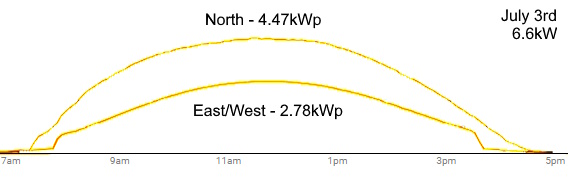
Keep in mind that in most solar PV systems, panels are not all facing the same direction. That means different sections of roof will peak at different times as the sun moves from east to west. If all your panels are facing the same way, you will see a higher peak power than someone whose panels are on multiple orientations. Below shows a north only facing 6.6kW system vs an evenly split east and west facing 6.6kW system on the same day / location. In winter, having north facing panels is usually best.
Most people will use between 300W and 2kW for much of the day time. If no-one is home, then it is often at the lower end. If someone is home then at the higher end. If people are home and it’s an all electric home (think heating!) or they have a pool then the power needed could be much high and a larger solar system will be needed to meet their needs. Below shows a pool owner’s energy usage on a typical winters day (with 6.6kW solar system)

How much energy will my panels generate in winter?
Energy generated is the sum of the power generated over time. Since power is lower in winter, and the days are shorter, the energy produced from the solar system will also be lower. We just need to take this into account when designing the system.
As you can see in the graph below, power is not constant for production or consumption which means it is impossible to align the system power (alone) with a clients needs. You need to know how much energy is required (and when).

In the graph above, you can see that there was excess energy generated at times but it stopped late in the afternoon. By obtaining the sum total of energy produced vs energy consumed, we can see that the client is often producing more energy than consumed on a day, and on other days it is not enough. See the graph below.

For the above client, the 6.6kW system is doing a reasonably good job in winter. It is covering all their daytime needs and often there is excess for charging the battery so they use very little grid energy used. Their usage is quite low but a larger household might need a larger system.
Do solar panels work on cloudy or overcast days?
There are often clouds blocking direct sunlight but there is still diffuse light which the panels can efficiently convert to energy, but the intensity is lower than direct light so the power is too. When diffuse lighting makes up most of the power, it almost doesn’t matter which way your panels are facing as the light is all around, not direct. On cloudy days there is not much difference between north, east or west panels. Even south facing panels will produce a similar amount.
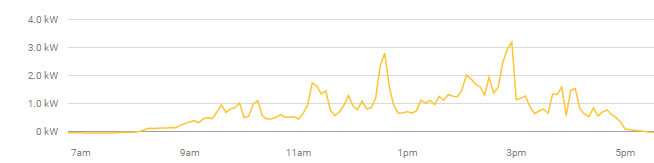
Notice in the graph below of a 6.6kW system’s output for a cloudy day that the output is up and down all day and not the bell shaped curve of a perfect sunny day.
Do solar panels work on rainy days?
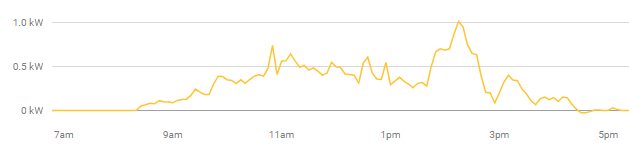
Water has no real impact on solar panel performance (it helps to keep them clean which has long term benefits) but a very rainy day is similar to a heavily overcast day so the output will be a bit lower again. This is the output of a 6.6kW solar system on the worst rainy day this year:
Can hail damage solar panels?
It is understandable that you would be concerned about hail damaging solar panels, particularly if you’ve been through severe hail storms in the past. Solar panels are made from glass so the thought of hail smashing them is a real fear for some.
The good news is that the solar industry has been dealing with this issue since day one and solar panels are designed to withstand most hail. Most panels are rated to withstand hail up to 25mm diameter falling at high speed. Hail larger than that won’t necessarily break the panel but if panels do become damaged, you will likely have damage to your property and both should be covered under home insurance. (Make sure to notify your insurance company you have solar if it’s not automatically covered).
If you have been through a severe hail storm, we strongly recommend having your panels inspected, even if they appear to be working. Very large hail can cause invisible micro-cracks that may cause ongoing performance issues or, in the worse case, a fire. A specialist can use thermal imagery and IV curve testing to ensure they are unaffected or if they are, provide the evidence to your insurance company.
Do solar panels work in the cold? How does temperature affect performance?
Solar PV panels can withstand a very wide range of temperatures, well with the range of temperatures seen in Victoria. You don’t have to worry about them breaking due to the extreme cold! (Solar hot water panels may have issues but solar PV panels are fine).
If snow builds up on the solar panels, obviously light can’t reach the cells and they won’t produce power. Luckily it usually blows off or melts in the sun so they start generating again once the snow clears.
The effect of temperature on solar panels is probably the only slight benefit to winter performance. Panel efficiency is greater at colder temperatures. However, this improved efficiency is imperceptible due to the lower light levels producing lower output. If the panels are on a very steep pitch facing north, then you would see close to 100% output at midday on perfect winter days.
Will adding a battery help in winter?
A battery does not generate energy itself so can only help to shift the excess energy generated from the sun in the daytime when you don’t need it to nighttime when you do. If your solar PV system is not large enough to generate excess energy, there will not be anything to charge the battery with an it will sit idle for much of winter.
With the changing electricity supply landscape, there is another way a battery can help in winter. A lot of retailers have time of use tariffs. At some times of the day, you get very cheap electricity and at other very times expensive electricity. This an attempt to level out the generation / consumption on the grid and improve grid reliability. If your solar system is not providing enough energy to fully charge the battery, you could use the cheap energy rates to charge the battery then use it to provide the power needed during the high rate period.
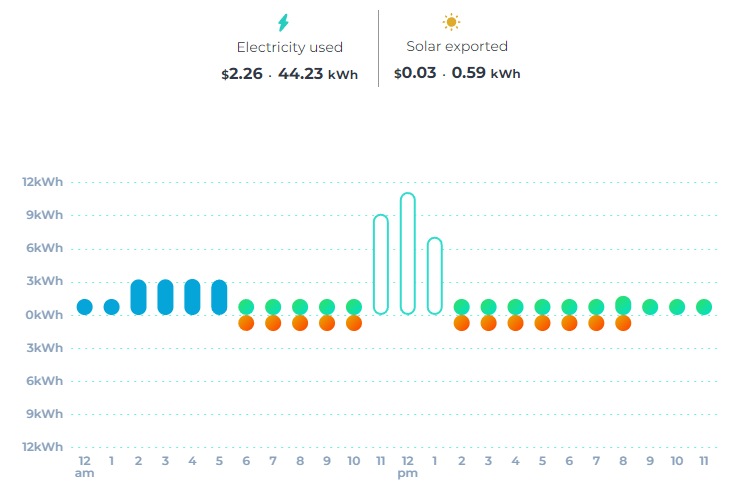
One company that does this very well is OVO Energy. We currently get free energy between 11am and 2pm and pay just 8c/kWh in the evening. By charging the battery for free (or cheaply), we don’t have to pay for any power in the afternoon / evening when it is the peak rate period. These plans change all the time so follow this link for a personal quote.
Here is an example where we used 44.23kWh for the day yet only paid $2.26 (or about 5.1c/kWh). This includes battery charging and over 100km worth of EV charging.
Should I stick to using gas in winter?
The cost of gas will continue to rise; remember the Victorian government has banned new gas connections so the gas retailers will have to put prices up to recoup costs from a smaller pool of customers.
Replacing gas appliances with energy efficient electrical alternatives like heat pumps for hot water, reverse cycle air conditioners for heating and cooling, induction cook tops for cooking etc. can greatly reduce your total energy costs. For example a heat pump will use perhaps 1/4 of the energy of a gas or old school electric hot water system.
If you can ween yourself of gas entirely, you can save at least $365 per year in gas connection fees on top of the energy savings.
If you have limited roof space for solar or you don’t use these appliances during the day, you won’t see as much savings from making the swap but it will be an improvement. If you can install a larger solar system and run these appliances during the day you will see massive ongoing savings.
Is solar worth it in winter?
As you can see, solar PV systems still produce usable energy in winter. The glory days of high feed in tariffs are over but by using most of our own generated energy in the daytime you we will get great value from a solar power system. You can still opt for a larger system even if you don’t need the energy in the daytime. A battery may be suitable in that case but in general, the more you generate, the less you will need from the grid which will just continue cost more and more in time.
You can leave it to experts to ask the right questions to design the system that is right for you. If they don’t ask any questions at all, you know you are getting a cookie cutter design that may or may not work for you. Contact us today to arrange a free consultation and we will make sure you don’t over invest in something you don’t need or feel ripped off with a system that doesn’t do what you want.


Comments are closed.